A short round still has a full price
Instant games can make individual rounds feel brief, which makes it useful to check the stake before focusing on speed. In Zora’s instant area, identify the exact title and provider before comparing settings. Plinko, Mines and crash-style games describe different mechanics; a common category does not make their controls or result calculations equivalent.
For a board-based game, examine what a paid start action commits and what later selections can change. For a risk selector, read how the selected option affects the displayed distribution or payout table. A higher or lower label does not by itself establish a favourable expected result. Use the rules of the actual implementation rather than a guide to a similarly named game.
Count repeated rounds as cumulative activity
An illustrative ten rounds at €0.50 create €5 of stakes, regardless of how quickly the screen moves. Fifty such rounds create €25 of stakes. These numbers are turnover, not a prediction of loss or a requirement to continue. The example explains why a small per-round amount can become substantial activity when actions are repeated rapidly.
Check whether an automatic mode is enabled and understand its stop controls before using it. Do not assume that a connection interruption cancels an accepted round. After a game or setting change, recheck the stake and selected balance rather than relying on the previous title’s controls. A useful instant-game session remains understandable at every step; speed is a product characteristic, not evidence that decisions require less attention.
Use the catalogue to identify the implementation
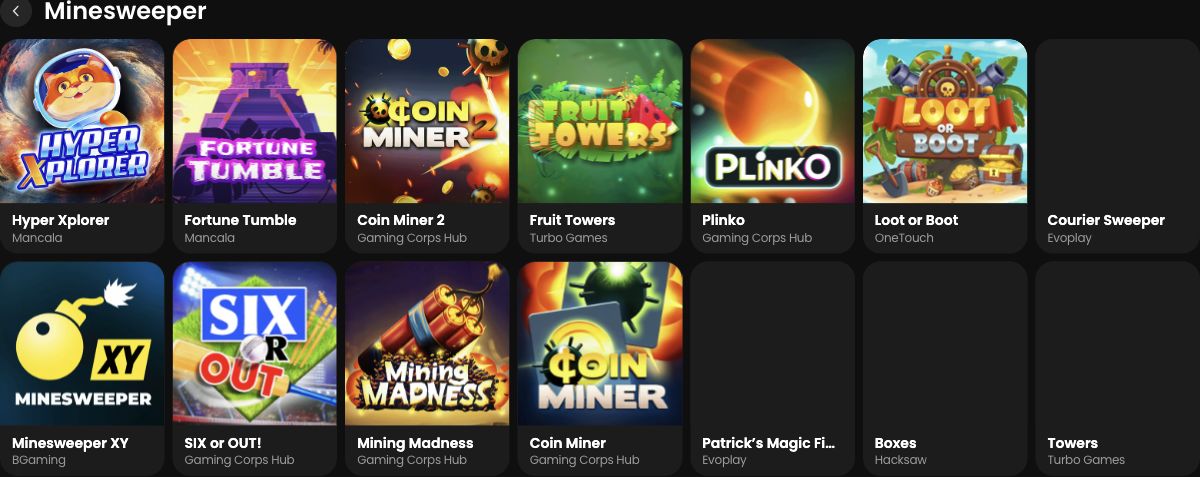
The instant category is a starting point, not a complete description of a game. A search for Chicken Road 2.0 showed an InOut title during the public Zora inspection. The full name and provider matter because a similar name or image could lead to a different release. This observation establishes a catalogue result, not an unverified RTP or a claim about every feature of that client.
For Plinko or Mines, make the same identity check before interpreting the board. If you change titles, begin the control check again. A setting remembered from another implementation may have a different meaning here. Record the visible options and leave unavailable or unexplained parameters unconfirmed instead of supplying a familiar number from another game guide.
Separate setup from the active-round screen
Before starting, locate the stake, any risk or board setting, and the information menu. Then establish what happens after the paid start: which decisions remain available and where the round ends. This is especially important when a board-selection button changes from a setup control into an action on an active round. Similar visual positions do not guarantee the same function at every stage.
In an illustrative Mines layout, a current collectable amount and a possible next-step amount are different values. The next-step figure is not already credited. In a Plinko client, a displayed multiplier may describe total return rather than profit. Find the relevant definition in the loaded game before applying a calculation. The navigation task is to locate the rule, not infer it from the most prominent number.
Confirm the stopping route before using repetition
If an automatic or batch mode is offered, identify the number of paid actions it schedules and what stopping does to actions already accepted. A stop control should not be assumed to reverse a completed stake. After stopping, compare the recorded number of rounds with the intended batch rather than counting only animations that were visible on the screen.
After a disconnection, return through the existing round or batch history. A new start is not a diagnostic tool for the prior result. Keep the exact title, mode and reference when asking Zora to explain an unclear status. A short-format game can be easy to enter, but a usable route also needs an understandable way to pause, inspect the record and leave without starting another paid action.