JUNCASINO / ZORA.BET
Sports guide
Start with the event, period and market
The sports section on Zora.bet is organised around events and the markets available for each event. Football, tennis, basketball, ice hockey, esports, table tennis and other sports require different reading habits because the unit being measured changes. Goals, sets, points, maps and periods are not interchangeable. Before comparing odds, identify the competition, the start time and whether the market applies to the entire event or a named segment.
Open Zora.bet · Sports guide and choose an event whose rules you understand. Then read the full market label, including any note about regular time, overtime, a set, a half or a map. A selection can look familiar while settling on a different period. This is why our guide puts the market description before the price: the odds are only meaningful after you know precisely what outcome would make the selection win.
Decimal odds: return and profit are different numbers
Decimal odds express the total return per unit staked when a selection wins, including the stake. In an illustrative example, a €10 single at odds of 2.40 returns €24 in total, of which €14 is profit. A losing €10 selection loses the stake. These example figures explain the arithmetic; they are not quoted prices for an event on Zora.
A second useful calculation is the implied probability, found by dividing one by decimal odds. Odds of 2.00 correspond to 50% before considering the bookmaker's margin. Odds of 1.50 correspond to about 66.7%, while 3.00 corresponds to about 33.3%. This does not reveal the true chance of the event. It is a way to describe what a price implies and to compare prices consistently.
The margin becomes clearer if you add the implied probabilities of all mutually exclusive outcomes in a simple market. If that sum exceeds 100%, the excess indicates an overround in those quoted prices. For example, two sides both at 1.90 imply approximately 52.63% each, or 105.26% together. This helps explain why choosing a short price is not the same as buying a low-risk investment.
Use the market tabs to ask a specific question
Observed event navigation includes Main, Total, Halves, Corners, Goals, Handicap, Intervals, Cards and Score, with availability varying by event. Main is a useful starting view, but the other tabs narrow the subject. A corners market concerns corners rather than goals; a cards market concerns the defined disciplinary statistic; an interval market concerns a specified portion of play. Read any associated explanation because counting rules can be more detailed than the tab label.
Totals ask whether a statistic finishes above or below a stated line. A half-point line such as 2.5 cannot be matched exactly by a whole-number goal count: three or more is above it, two or fewer is below it. A whole-number line can introduce a push under applicable rules when the result lands exactly on the line. Do not apply the half-point logic to every form of total without checking the market.
Handicap markets adjust the comparison between the participants. The sign matters, as does the period to which the adjustment applies. Write the selection as the team plus its handicap before confirming. With more complex split lines, understand how the stake is divided and how each part settles. If the calculation is unclear, a simpler market is easier to verify than guessing from a short label.
Football: distinguish goals, result and side statistics
A football match can support several predictions that do not move together. A team can win a low-scoring match, take fewer corners than its opponent, or collect more cards despite having less possession. Match result, total goals and corners therefore need separate reasoning. The fact that selections concern the same fixture does not make one a reliable substitute for another.
For a match-result selection, check whether the market is a three-way result including the draw or a different format. For a goals selection, identify the line and whether it covers both teams or one team. For a half-specific selection, remember that a first-half bet may be settled before the full-match result is known. The score shown in the event header does not by itself answer every market.
Correct-score and interval markets are more precise predictions. They can display larger odds because they require a narrower outcome, but a large price does not make them better value automatically. The practical benefit of Zora's separate tabs is navigation: use them to locate the statistic you mean, not to add more selections simply because more markets are visible.
Tennis, basketball, hockey and esports need their own checks
In tennis, the difference between a match winner, set winner, games total and handicap is fundamental. A player may lose a match after winning a set or covering a games handicap. Retirement and walkover rules are particularly relevant because an unfinished match may not settle every market in the same way. Read the rules for the specific selection rather than assuming that all bets become void together.
Basketball totals and handicaps depend on the named game period and on whether overtime is included. A first-quarter market is settled on that quarter, while a full-game market may follow a different overtime rule. Ice hockey also makes the distinction between regulation-time and extended-result markets important. Identify whether the draw remains an available outcome and whether overtime or a shootout is included.
Esports adds another layer: the event may be a series with several maps, while the market may concern one map, the series winner or a specific in-game statistic. Check the game title, series format and map designation. A familiar team name is not enough if the market refers to a different roster, competition stage or map from the one you intended.
Live betting: the accepted slip is the decisive record
In-play markets respond to the event as it develops. Prices can move, markets can be suspended and the displayed score can arrive with a delay relative to the action. The useful habit is to slow down at the confirmation stage: check the event, current period, selected line, stake and accepted odds. A selection first viewed at one price may be offered at another by the time you submit it.
If the interface asks whether to accept changed odds, read that setting before continuing. Also distinguish an unconfirmed slip from a successfully accepted bet. A network interruption or a spinning confirmation indicator is not evidence that the bet was placed. Check the account's bet history before trying again. This reduces the risk of accidentally submitting the same intention twice.
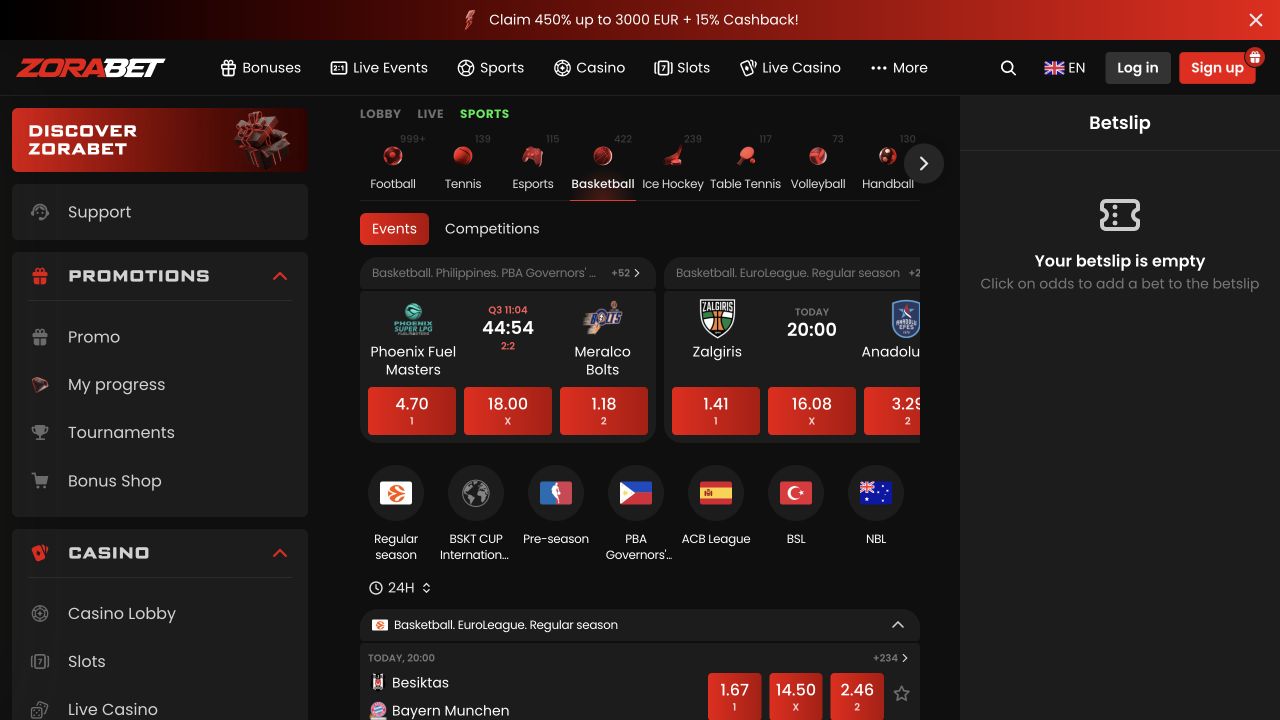
Live information is helpful context, but it does not remove uncertainty. A team that is leading can still lose, and a high-scoring opening period does not guarantee that a total will finish over its line. Screenshots in this guide illustrate the layout only. They should never be used as a current source of prices or match status.
Singles, accumulators and Bet Builder
A single settles on one selection. An accumulator combines several selections into one bet and normally needs each leg to succeed, subject to the applicable void and settlement rules. In an illustrative two-leg example, odds of 1.80 and 2.00 multiply to 3.60. A €5 stake would return €18 if both legs won. If one leg loses, the combined bet ordinarily loses rather than paying the winning leg separately.
The combined price can look attractive while the chance of all required outcomes becomes smaller. Adding a selection that feels likely still adds another condition. For review purposes, compare the accumulator with the individual selections: can you explain why every leg is included, and does each event's period and market match the intention? The multiplier alone is not a reason to keep adding legs.
Bet Builder concerns combining supported selections from the same event. Those selections can be related, so the displayed builder price should not be reconstructed by blindly multiplying individual prices. Availability and permitted combinations depend on the event and the product's rules. Read the final builder description as one complete proposition, including what happens if a leg is void or a player does not participate.
Sports bonuses and settlement questions
The public sports welcome package advertises 500% up to €3,000. Open Sport Welcome for the stages and qualifying rules, then compare it with the way you intend to bet. Minimum qualifying odds, eligible market types, required turnover and deadlines are more useful decision points than the headline alone. Do not assume the Slots free spins are also part of a sports package.
When a bet settles differently from your expectation, start with the record: event name, market, selected period, accepted odds, stake and settlement status. Compare that record with the published rule that applies. A postponed event, an abandoned match, a tennis retirement or a corrected statistic can require different treatment. A general statement such as “my team won” may not resolve a bet on a half, handicap or side statistic.
If a cash-out option appears on a supported bet, assess the displayed amount as a separate offer at that moment. Availability is not guaranteed throughout an event, and a cash-out amount need not equal the original potential return. Read any confirmation carefully. Our Payments & account FAQ covers practical account questions, while Bonus comparison explains promotional terminology that can affect a sports balance.
A repeatable check before every confirmation
A short routine is more useful than a collection of predictions. First verify the event and time zone. Next read the market and period aloud in plain language. Then check the line, odds and stake in the slip. Finally confirm that the possible return means total return, not profit, and that the amount risked fits the budget chosen before browsing. These checks apply to both pre-match and live betting.
Keep the session budget separate from the potential return shown on the screen. A displayed payout is conditional on the selection winning; it is not money already earned. After a loss, increasing the next stake does not repair the probability of that earlier decision. The same principle applies to a promotional target: a remaining turnover requirement is a condition to understand, not an instruction to spend beyond your limit.
On a smaller screen, expand the slip and read the full selection rather than relying on a truncated event label. A clear, deliberate confirmation is especially useful when switching between categories or returning from another app. Zora's range of sports and market tabs can make navigation flexible; a consistent reading routine makes that flexibility easier to use accurately.
The better price must still describe the same bet
Two prices can only be compared sensibly when the underlying selection is identical. A team to win in regulation time is not the same proposition as a team to qualify, and a player to score at any time is different from the player scoring first. Even a familiar “winner” label needs its period and event scope. When browsing Zora.bet · Sports guide, compare the participant, market, line and settlement period together before deciding that one number is better than another.
Consider two hypothetical basketball selections: the home team at minus 4.5 and the same team at minus 5.5. A five-point win would satisfy the first handicap but not the second under the usual interpretation of those lines. A larger decimal price on the second selection therefore buys a different outcome requirement. It is not simply a more generous version of the first bet. These figures illustrate line comparison and are not current Zora markets or predictions.
The same reasoning applies to totals. Over 2.5 and over 3.5 goals need different final counts; first-half and full-match totals count different periods. A useful comparison note has room for both price and line. Without both, a screenshot or remembered price is incomplete. If the line changes while a slip is open, reread the selection rather than treating the change as an odds adjustment alone.
Separate a result correction from a price movement
The accepted odds describe the price recorded when a bet is confirmed. Settlement determines how the recorded selection is graded against its applicable rules. A later change in the public price does not by itself explain why an accepted selection won, lost or was voided. Conversely, a corrected statistic, an abandoned fixture or a competition-specific rule may affect settlement without being a question about odds at all.
To investigate a discrepancy, arrange the information in that order: the accepted selection, the event outcome relevant to that market, and the rule used for settlement. For example, a complaint about a cards market should identify the cards definition rather than only the final match score. If contacting support, include the bet identifier and ask which rule was applied. This makes the question answerable without sharing unnecessary personal documents in a general conversation.
Our Sports guide covers price arithmetic, but arithmetic cannot resolve every rules question. For complex combinations, inspect the treatment of a void leg and the remaining selections in the actual bet history. Do not replace the displayed settlement with a calculation based on assumptions about another bookmaker or another market format.
What an implied probability does and does not tell you
Decimal odds can be translated into an implied probability using one divided by the price. In a hypothetical two-outcome market, odds of 1.80 imply approximately 55.56%, while 2.10 imply approximately 47.62%. Their sum is about 103.18%. The amount above 100% is the market's overround in this simple calculation. It helps explain why quoted prices should not automatically be read as a fair probability forecast. These are teaching figures, not live prices or an assessment of a specific Zora event.
The calculation only makes sense when the outcomes belong to the same complete market. A football home-win price and an away-win price do not form a complete three-way market if the draw is missing. Combining prices from different moments or different settlement periods is equally misleading. When inspecting Zora.bet · Sports guide, write down the full set of outcomes and the period first. Only then use the reciprocal calculation to understand the structure of the prices.
An implied probability is not your chance of making a profit over a session. It does not incorporate your selection quality, stake choices, correlation between bets or the possibility that your interpretation of the market is wrong. A lower price describes a different quoted return, not a guarantee. Treat probability arithmetic as a tool for reading a market, alongside the settlement explanation in our Sports guide, rather than as a method for predicting results.
Whole, half and quarter lines lead to different settlements
A half-goal total such as 2.5 separates two possible counts without an exact tie at the line. A whole-goal total such as 2.0 can introduce a push when exactly two goals are scored, if the applicable rules use that convention. A quarter line normally divides the stake between two neighbouring lines. The label and the operator's rules must identify the actual format; do not apply this explanation to an unrelated handicap merely because its number looks similar.
For illustration, an Asian total over 2.25 commonly splits a hypothetical €20 stake into €10 over 2.0 and €10 over 2.5. With exactly two goals, the first part is returned and the second loses under that standard convention: a half loss. With three goals, both parts win. With one goal, both lose. The potential return still depends on the accepted price. This example explains the split, not the availability of a particular market on Zora.
Combinations make this distinction more important. A push, half win or half loss is not always equivalent to deleting a selection and multiplying the remaining headline prices. Examine the settled parts and the calculation shown in the bet history. If a record is unclear, ask which line, period and result were used. A precise question about the settlement of a named selection is more useful than comparing the displayed return with a calculation built from an incomplete market label.